Life Sciences & Healthcare
Neuroscience
Uncover dynamical laws governing neural activity from EEG, fMRI, and electrophysiology recordings.
One of 34 industries across 8 sectors served by ARDA — the research discovery engine.
The Challenge
Why Neuroscience needs a new approach to discovery
Neuroscience generates some of the most complex time-series data in biology — EEG recordings, fMRI BOLD signals, multi-electrode electrophysiology, calcium imaging — where the underlying dynamics involve regime transitions, oscillatory behavior, nonlinear coupling, and causal connectivity across distributed neural populations. These datasets encode the governing equations of brain function, from single-neuron firing patterns to large-scale network coordination. Yet the dimensionality, temporal complexity, and regime-dependent nature of neural data make extracting the mathematical laws governing neural system behavior exceptionally difficult through conventional analytical methods.
Standard neuroscience analysis methods — spectral decomposition, event-related averaging, general linear models, independent component analysis — reduce data to summary statistics that discard the dynamical structure encoding how neural systems evolve, transition, and interact over time. Connectivity analysis based on correlation or coherence cannot distinguish causal influence from shared input or common drive. The regime-dependent nature of neural dynamics — where the governing equations themselves change across brain states — violates the stationarity assumptions embedded in most standard time-series analysis frameworks used across neuroimaging and electrophysiology research.
The ARDA Approach
How ARDA transforms neuroscience
ARDA discovers the governing equations of neural dynamics directly from recording data, identifying the mathematical laws that describe how neural populations interact, synchronize, and transition between activity states. Rather than reducing neural data to static summary measures, ARDA captures the full dynamical structure — oscillatory coupling, regime transitions, and directed causal interactions — as typed scientific claims. This approach reveals governing relationships that standard analyses structurally miss: state-dependent connectivity changes, nonlinear coupling dynamics, and the transition rules governing shifts between distinct neural activity regimes.
ARDA's regime classification automatically identifies distinct brain states and characterizes their transition dynamics — essential for understanding how neural systems switch between resting, task-engaged, and pathological states. The Symbolic mode discovers oscillatory laws governing neural rhythms and coupling relationships between frequency bands. The Causal mode maps effective connectivity — directed causal relationships between brain regions — from observational recordings without requiring invasive interventions. Negative Controls including time shuffle and phase randomization ensure that discovered connectivity reflects genuine causal influence rather than volume conduction, shared input, or statistical artifacts in the recording.

Discovery Engine
The engine behind the discovery
Causal mode and Symbolic modes are the primary discovery engines for neuroscience. Causal mode produces directed causal graphs of effective connectivity, resolving the fundamental limitation of correlation-based methods that cannot establish causal direction between brain regions. Symbolic mode discovers closed-form oscillatory equations and coupling laws governing neural rhythms — relationships that neuroscientists can directly compare against theoretical models of neural dynamics. Neuro-Symbolic mode serves high-dimensional recording modalities like calcium imaging and high-density electrophysiology, where neural encoding captures spatial-temporal structure before symbolic distillation extracts interpretable dynamical laws.

Symbolic
Discovers closed-form governing equations — the explicit mathematical laws that describe how systems behave. Produces human-readable, interpretable formulas.

Neural
Deploys physics-informed architectures for high-dimensional, symmetry-rich data where closed-form solutions may not exist.
Neuro-Symbolic
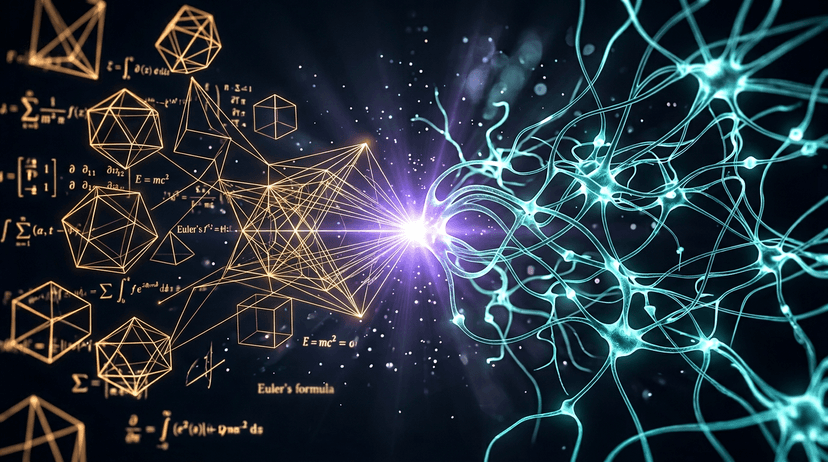
Combines neural encoding with symbolic distillation — learns complex representations first, then extracts interpretable governing laws from those representations.

CDE
The Causal mode, powered by ARDA's Causal Dynamics Engine (CDE), discovers true cause-and-effect relationships from observational data — identifiable causal graphs, regime classifications, and intervention predictions.
Typed Scientific Claims
What ARDA discovers
Every discovery ARDA produces is a typed scientific claim — not a black-box prediction, but a governed, reproducible, auditable piece of scientific knowledge with full provenance.
- Neural oscillation governing equations
- Brain state regime classifications
- Effective connectivity causal graphs
- Seizure dynamics transition models
- Neural population coupling laws



Governed Discovery
Built for regulated industries
Every discovery ARDA produces carries governance metadata: a Truth Dial setting that controls the confidence threshold, an evidence ledger entry with deterministic replay recipe, and negative control results including bootstrap stability, out-of-distribution testing, and feature shuffle validation.
For neuroscience, this means every scientific claim is auditable, reproducible, and suitable for regulatory submission, peer review, or board-level decision-making. The governance stack is not optional — it is embedded in every discovery run.
Same sector
Related industries
Pharmaceutical R&D
Accelerate drug discovery by identifying molecular interaction laws, binding dynamics, and pharmacokinetic equations from experimental assay data.
ViewBiotechnology
Discover the causal structures governing biological systems — from CRISPR outcomes to protein folding dynamics — directly from experimental time-series.
ViewClinical Research
Identify causal treatment effects and patient response dynamics from clinical trial data with ARDA's causal dynamics capability.
ViewGenomics & Proteomics
Discover gene regulatory networks and protein interaction dynamics from high-throughput sequencing and mass spectrometry data.
ViewEpidemiology & Public Health
Model disease transmission dynamics, identify causal risk factors, and discover the governing equations of epidemic spread.
ViewGet started
Start discovering with ARDA
Whether you are exploring neuroscience data for the first time or scaling an existing research programme, ARDA adapts to your workflow. Create an account, connect your data, and let the engine surface the governing laws hidden in your experiments.