Materials & Chemistry
Polymer Science
Identify governing equations of polymer dynamics — viscoelastic laws, crystallization kinetics, and degradation mechanisms.
One of 34 industries across 8 sectors served by ARDA — the research discovery engine.
The Challenge
Why Polymer Science needs a new approach to discovery
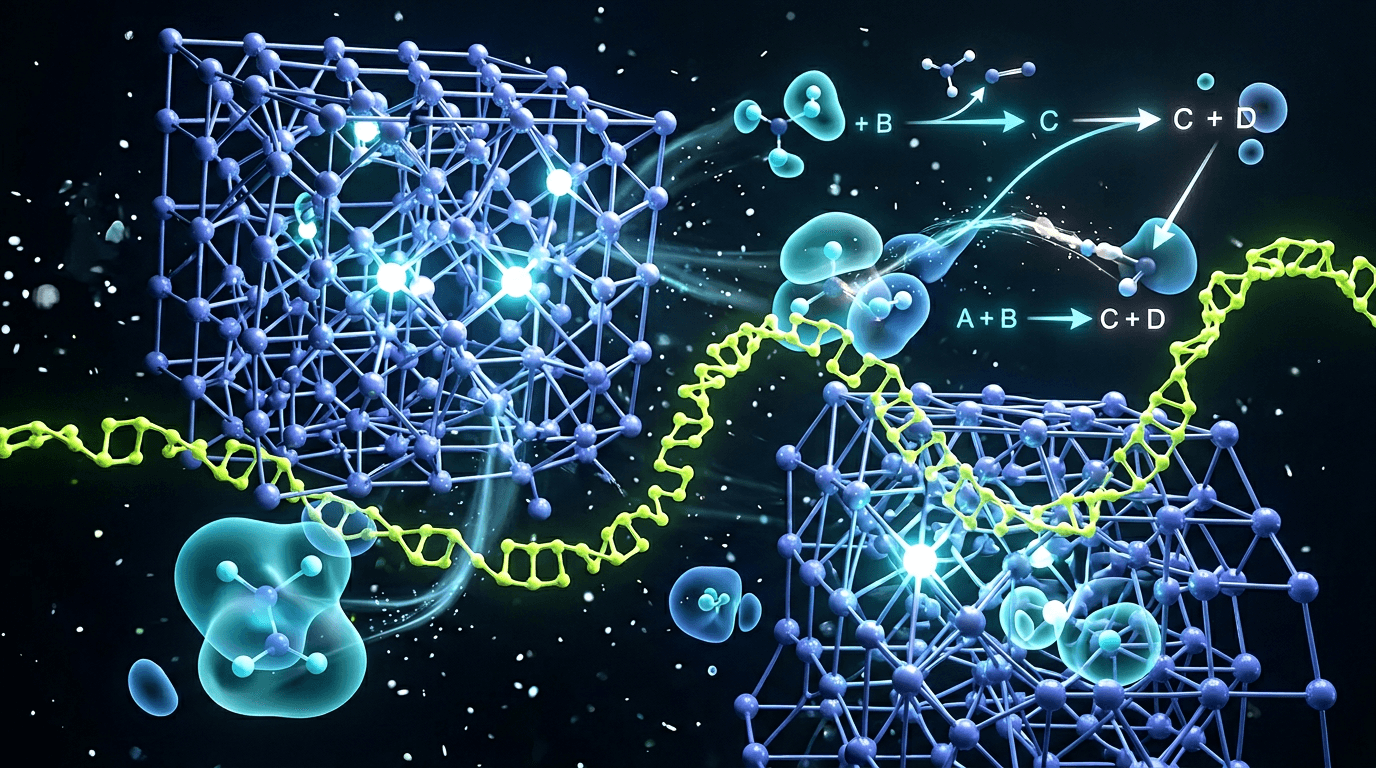
Polymer materials exhibit complex behavior that spans molecular, mesoscopic, and macroscopic scales — viscoelastic response, crystallization kinetics, thermal degradation, and mechanical fatigue all depend on molecular weight distribution, chain architecture, processing history, and environmental conditions. Characterization data from rheometry, differential scanning calorimetry, dynamic mechanical analysis, and accelerated aging studies encodes these governing relationships, but their extraction remains fragmented. Researchers typically analyze each property in isolation, fitting standard models to individual datasets without capturing the cross-property dependencies that determine real-world material performance.
Standard constitutive models for polymer behavior — Maxwell, Kelvin-Voigt, generalized linear viscoelastic frameworks — assume idealized conditions that rarely hold for commercial polymer systems. Crystallization models rely on nucleation theories calibrated under isothermal conditions, yet industrial processing involves complex thermal histories. Degradation studies apply single-mechanism Arrhenius fits to phenomena that often involve multiple competing pathways. The multi-scale nature of polymer dynamics, where molecular chain motion governs bulk properties, means that purely empirical models lack predictive power outside their calibration range, while first-principles molecular simulations cannot yet reach the timescales relevant to engineering applications.
The ARDA Approach
How ARDA transforms polymer science
ARDA ingests raw polymer characterization data — rheological master curves, DSC thermograms, stress-strain measurements, aging time-series — and produces typed scientific claims about the governing equations of polymer behavior. Rather than fitting predetermined constitutive forms, ARDA discovers the functional relationships that best explain viscoelastic response, crystallization kinetics, and degradation dynamics from the data itself. This data-driven approach captures non-standard behavior that falls outside classical model assumptions, such as strain-dependent relaxation spectra or coupled thermal-mechanical degradation pathways that standard frameworks cannot represent.
ARDA's Neuro-Symbolic mode addresses the multi-scale challenge directly: neural encoders capture complex chain-level dynamics from molecular simulation or scattering data, while symbolic distillation extracts the macroscopic constitutive equations that materials engineers need for product design and process optimization. The Truth Dial lets teams set appropriate confidence thresholds for different applications — exploratory formulation screening versus final product qualification. The Evidence Ledger ensures that every discovered property law is reproducible, with negative controls validating stability across different molecular weight ranges and processing conditions.

Discovery Engine
The engine behind the discovery
The Neuro-Symbolic mode is most valuable for polymer science, bridging molecular-scale dynamics and bulk material behavior through neural encoding followed by symbolic distillation into interpretable constitutive laws. The Symbolic mode identifies crystallization rate equations, degradation kinetics, and mechanical response laws directly from testing data. Causal mode maps causal relationships between formulation variables — monomer ratios, additive concentrations, processing temperatures — and final material properties, enabling systematic optimization of polymer formulations. Together, these modes replace the iterative trial-and-error approach to polymer development with a governed, reproducible discovery workflow.

Symbolic
Discovers closed-form governing equations — the explicit mathematical laws that describe how systems behave. Produces human-readable, interpretable formulas.

Neural
Deploys physics-informed architectures for high-dimensional, symmetry-rich data where closed-form solutions may not exist.
Neuro-Symbolic
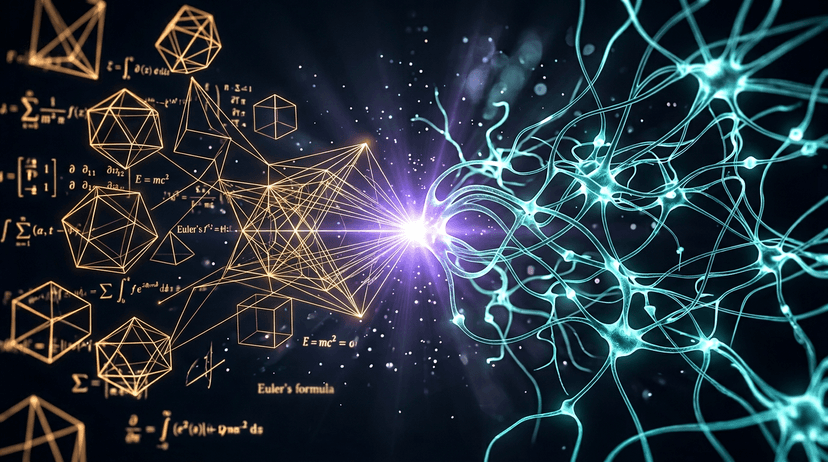
Combines neural encoding with symbolic distillation — learns complex representations first, then extracts interpretable governing laws from those representations.

CDE
The Causal mode, powered by ARDA's Causal Dynamics Engine (CDE), discovers true cause-and-effect relationships from observational data — identifiable causal graphs, regime classifications, and intervention predictions.
Typed Scientific Claims
What ARDA discovers
Every discovery ARDA produces is a typed scientific claim — not a black-box prediction, but a governed, reproducible, auditable piece of scientific knowledge with full provenance.
- Viscoelastic constitutive equations
- Crystallization kinetics laws
- Degradation rate models
- Processing-property relationships
- Chain dynamics governing equations



Governed Discovery
Built for regulated industries
Every discovery ARDA produces carries governance metadata: a Truth Dial setting that controls the confidence threshold, an evidence ledger entry with deterministic replay recipe, and negative control results including bootstrap stability, out-of-distribution testing, and feature shuffle validation.
For polymer science, this means every scientific claim is auditable, reproducible, and suitable for regulatory submission, peer review, or board-level decision-making. The governance stack is not optional — it is embedded in every discovery run.
Same sector
Related industries
Materials Science
Analyze molecular dynamics trajectories with physics-informed architectures to discover material property laws and phase transitions.
ViewChemical Engineering
Discover chemical reactor dynamics, reaction rate laws, and conservation equations with workflows suited to reactor and separation train data.
ViewNanotechnology
Discover governing physics at the nanoscale — quantum confinement, surface energy laws, and self-assembly dynamics.
ViewGet started
Start discovering with ARDA
Whether you are exploring polymer science data for the first time or scaling an existing research programme, ARDA adapts to your workflow. Create an account, connect your data, and let the engine surface the governing laws hidden in your experiments.