Cross-Industry Applications
Telecommunications
Identify signal propagation laws, network traffic dynamics, and interference equations from measurement data.
One of 34 industries across 8 sectors served by ARDA — the research discovery engine.

The Challenge
Why Telecommunications needs a new approach to discovery
Telecommunications networks produce continuous streams of performance data — signal strength measurements, packet loss statistics, latency profiles, throughput metrics, handover success rates, spectrum utilization — that encode the governing dynamics of network behavior across heterogeneous infrastructure. These dynamics are shaped by signal propagation physics, traffic flow patterns, interference interactions, and capacity constraints that vary across geography, time of day, and network load. As networks grow in complexity with densification, spectrum sharing, and edge computing, understanding the governing relationships between network parameters and service quality becomes increasingly critical for planning and optimization.
Standard network engineering approaches rely on propagation models calibrated to idealized conditions, empirical drive-test data, and rule-based capacity planning that do not capture the full complexity of real-world network dynamics. Interference management uses static coordination that cannot adapt to time-varying traffic patterns. Machine learning approaches improve prediction but produce opaque models that network engineers cannot interpret or use to diagnose root causes of quality degradation. The inability to separate infrastructure effects from traffic patterns from environmental conditions limits the effectiveness of current network optimization and troubleshooting methodologies.
The ARDA Approach
How ARDA transforms telecommunications
ARDA ingests network measurement data — signal propagation recordings, traffic flow statistics, interference measurements, quality of service metrics — and produces typed scientific claims about the governing dynamics of telecommunications systems. Its discovery modes identify signal propagation equations, traffic flow laws, and interference interaction models without requiring idealized assumptions about channel conditions or traffic distributions. ARDA discovers the mathematical relationships governing network behavior directly from operational data, capturing the site-specific, time-varying dynamics that generic propagation models and empirical calibrations miss.
ARDA's regime classification identifies network performance state transitions automatically — congestion onset, capacity saturation, handover degradation modes — enabling proactive network management before service quality impacts subscribers. The Causal mode separates genuine causal drivers of quality degradation from correlated symptoms, identifying whether performance issues originate from infrastructure faults, traffic overload, interference sources, or environmental conditions. Every network discovery is governed through the Evidence Ledger with deterministic replay, supporting the documentation requirements of regulatory compliance and vendor performance evaluation.
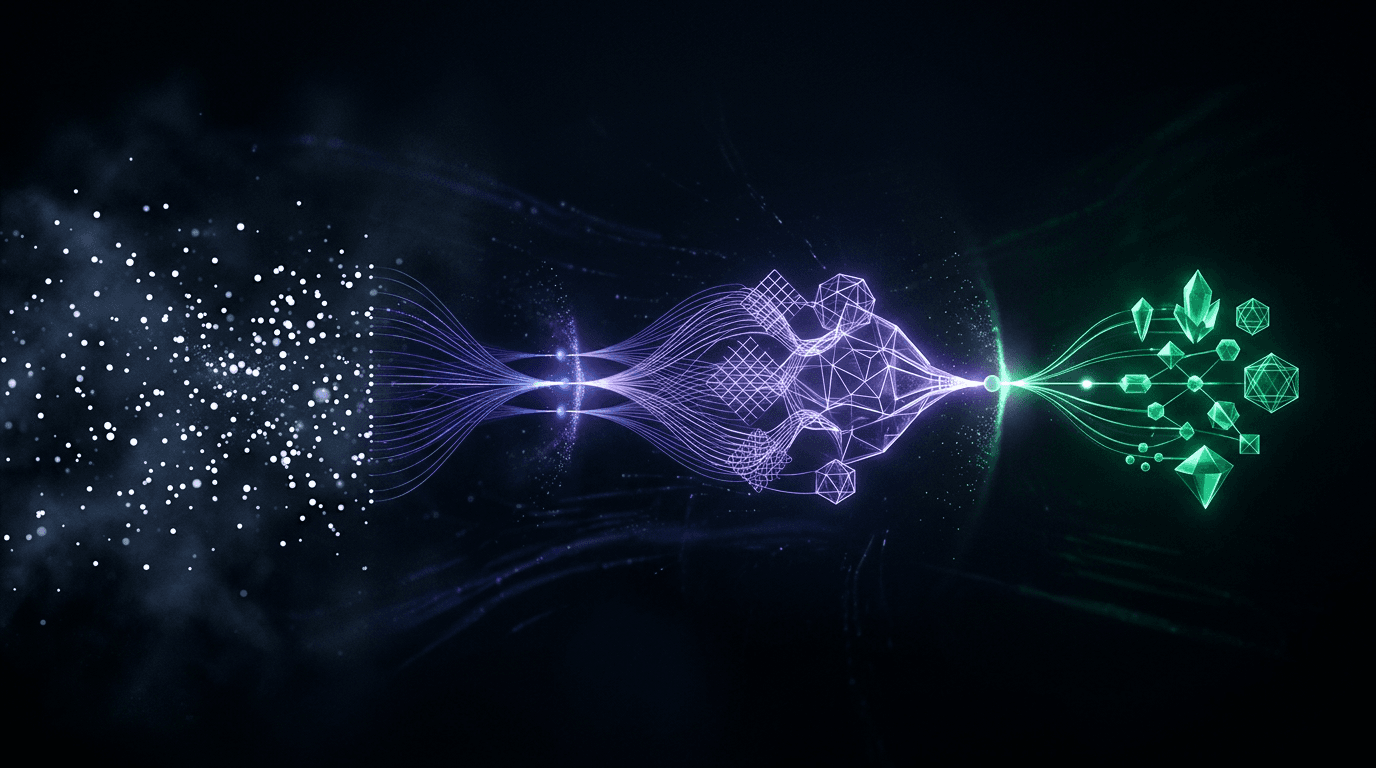
Discovery Engine
The engine behind the discovery
The Causal mode and Symbolic modes are most valuable for telecommunications. Causal mode maps causal relationships between network parameters, traffic conditions, and service quality, enabling root-cause diagnosis that separates infrastructure issues from load-dependent effects. The Symbolic mode discovers closed-form propagation equations, capacity scaling laws, and interference models specific to deployment conditions, producing interpretable models that network engineers can validate and implement. Regime classification provides automated detection of network state transitions, enabling dynamic optimization that adapts to changing traffic patterns and environmental conditions.

Symbolic
Discovers closed-form governing equations — the explicit mathematical laws that describe how systems behave. Produces human-readable, interpretable formulas.

Neural
Deploys physics-informed architectures for high-dimensional, symmetry-rich data where closed-form solutions may not exist.
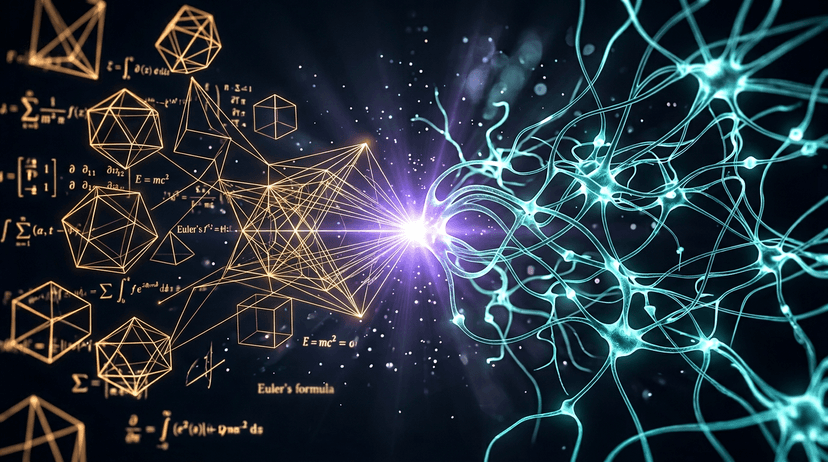
Neuro-Symbolic
Combines neural encoding with symbolic distillation — learns complex representations first, then extracts interpretable governing laws from those representations.
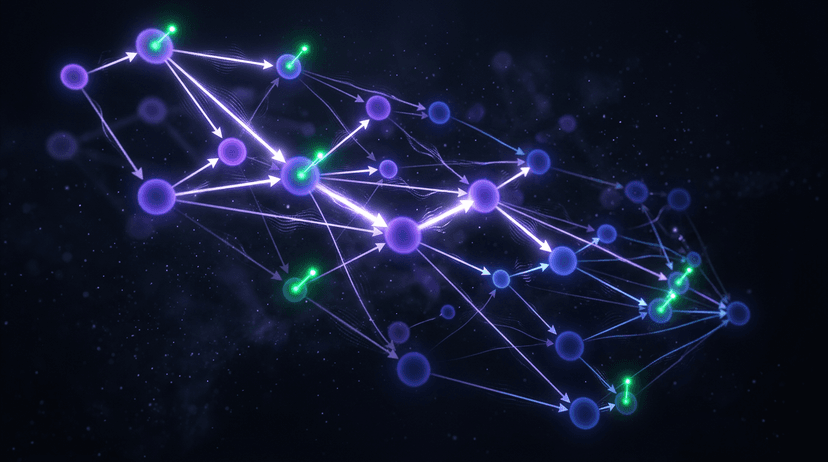
CDE
The Causal mode, powered by ARDA's Causal Dynamics Engine (CDE), discovers true cause-and-effect relationships from observational data — identifiable causal graphs, regime classifications, and intervention predictions.
Typed Scientific Claims
What ARDA discovers
Every discovery ARDA produces is a typed scientific claim — not a black-box prediction, but a governed, reproducible, auditable piece of scientific knowledge with full provenance.
- Signal propagation equations
- Traffic flow dynamics
- Interference governing models
- Capacity scaling laws
- Quality degradation causal models



Governed Discovery
Built for regulated industries
Every discovery ARDA produces carries governance metadata: a Truth Dial setting that controls the confidence threshold, an evidence ledger entry with deterministic replay recipe, and negative control results including bootstrap stability, out-of-distribution testing, and feature shuffle validation.
For telecommunications, this means every scientific claim is auditable, reproducible, and suitable for regulatory submission, peer review, or board-level decision-making. The governance stack is not optional — it is embedded in every discovery run.
Same sector
Related industries
Agriculture & Food Science
Discover crop growth dynamics, yield prediction laws, and soil-plant-atmosphere interaction equations.
ViewSupply Chain & Logistics
Discover governing dynamics of supply chain behavior — demand propagation, inventory oscillations, and disruption cascades.
ViewAcademic Research
A discovery engine for universities and research institutions across every scientific discipline.
ViewGet started
Start discovering with ARDA
Whether you are exploring telecommunications data for the first time or scaling an existing research programme, ARDA adapts to your workflow. Create an account, connect your data, and let the engine surface the governing laws hidden in your experiments.